

The Vault Your AI Cannot Open

Building an AI-Excluded Zone for Sensitive Organisational Data Before the Problem Finds You
There is a version of this conversation that happens in boardrooms about three years too late. A breach investigation reveals that an employee pasted a sensitive commercial contract into ChatGPT to get a quick summary. Another copied internal HR performance data into Claude to draft a termination letter. A third uploaded a draft merger document to a browser-based AI tool because it was faster than reading it themselves. None of them acted maliciously. All of them caused serious problems.
The organisations responding to those incidents are not bad at security. They simply treated AI governance as a training problem when it was also an architecture problem. Training tells people what not to do. Architecture makes certain things structurally impossible.
This post is about building that architecture before you need it.
The Honest Problem With AI Governance As It Stands
Most enterprise AI governance frameworks in 2026 sit somewhere on a spectrum between "we issued a policy document" and "we blocked ChatGPT at the firewall." Neither is sufficient. Policy documents are only as good as the people reading them under time pressure. Blanket blocking is a speed bump that drives shadow IT behaviour through personal devices and hotspots.
The more sophisticated organisations have moved to managed AI platforms such as Microsoft 365 Copilot with Purview controls, Salesforce Einstein, or internally hosted models. These are real steps forward. Microsoft Purview's AI Hub and Data Security Posture Management for AI now provide genuine visibility into how AI agents interact with enterprise data, applying sensitivity labels and encryption that carry through into AI-generated outputs.
But here is the honest gap. None of these controls fully solve the problem of an employee who can legitimately access a sensitive document, save a local copy, and feed it to an external model on a personal device or through a browser. For truly sensitive categories of data such as M&A documents, litigation strategy, government contracts, clinical trial data, and personal information at scale, the risk tolerance for any data leaving the organisation's control is effectively zero.
That requires something different. It requires building a zone where the data and AI cannot coexist, enforced at the technical and process level rather than just the policy level.
Introducing the Concept of an AI-Excluded Zone
An AI-Excluded Zone (AEZ) is not simply an air-gapped network in the traditional sense. It is a controlled environment designed around a specific principle. Any document or dataset classified as AEZ-tier cannot be opened, accessed, modified, or transmitted in any environment where an AI model, whether local or remote, has the technical ability to ingest it.
This is meaningfully different from just cutting the internet. A modern AEZ needs to account for local AI models running on endpoints (Ollama and LM Studio are now trivial to install on a standard laptop), AI features embedded in productivity software including grammar checkers and document summarisation built directly into Office applications and PDF readers, clipboard and screenshot pathways that can silently transfer content from a secure environment to an AI-capable one, and browser-based AI tools accessible through standard enterprise networks even when named platforms are blocked.
The goal is not to make the data hard to leak. The goal is to make it structurally impossible to process with an AI model without an intentional, audited, organisationally approved exception.
The Architecture
A well-constructed AEZ in 2026 is built across four layers: data classification, network and endpoint controls, the secure repository itself, and the access workflow governing who can enter it and under what conditions. Each layer reinforces the others. Removing any one of them creates a gap that motivated employees will find.
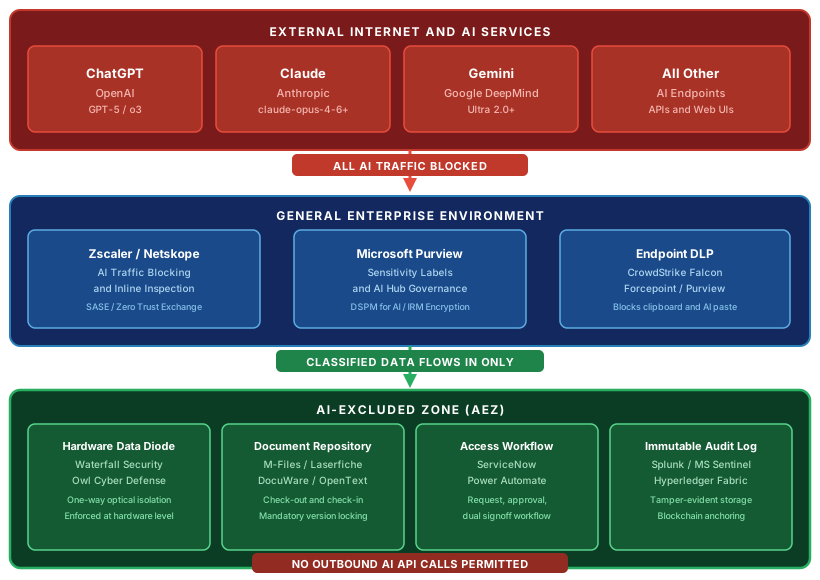
Figure 1. The four-layer AEZ architecture. All AI traffic is blocked at the enterprise perimeter. Classified data flows into the AEZ through a hardware data diode and cannot exit via any AI-capable pathway.
Classification and Labelling
Nothing works without knowing what belongs in the AEZ. This starts with a data classification framework that defines AEZ-tier data clearly. Examples include documents related to pending litigation, unpublished financial results, active M&A activity, classified government material, and personally sensitive HR records above a certain threshold.
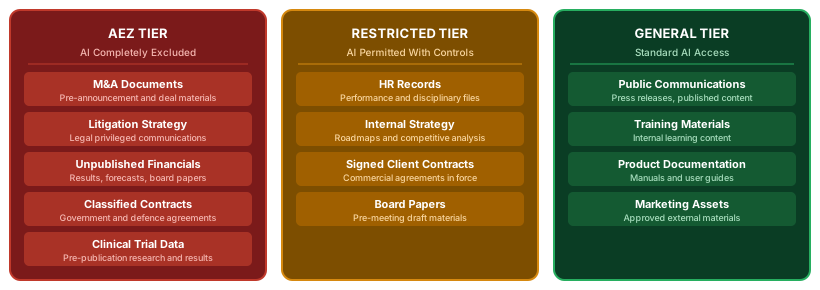
Figure 2. Data classification tiers. Only AEZ-tier data requires the full exclusion architecture. Classification is the foundation every other control depends on.
Microsoft Purview Information Protection provides the current benchmark. Sensitivity labels applied at creation time travel with the document through copy, export, and conversion operations. They enforce encryption that requires specific usage rights, including restricting the EXTRACT right that AI tools need to return content from labelled data. Combined with the Data Lifecycle Management features being rolled out through 2026, these labels can also govern retention and deletion of AI-generated outputs that reference protected source material.
For organisations outside the Microsoft ecosystem, equivalent capability exists through OpenText Documentum, Forcepoint Data Classification, or BigID's data discovery and classification platform, which uses machine learning locally to identify and tag sensitive data without sending it externally.
Network and Endpoint Controls
Once data is classified, the network and endpoint layer enforces that it cannot reach AI-capable environments.
Zscaler Zero Trust Exchange categorises AI and ML applications as a distinct URL class. This allows policy enforcement that blocks, warns, or isolates access to generative AI platforms across the entire fleet, with granularity down to specific actions such as file upload or text paste. Netskope's Cloud Security Platform provides comparable control, with particular strength in monitoring and restricting sensitive data pasted into tools like ChatGPT, Claude, Gemini, and their successors. In 2026 this is no longer a niche capability. It is table-stakes enterprise security.
Endpoint DLP extends this to cover local activity that never touches the network. Microsoft Purview Endpoint DLP, Forcepoint, and CrowdStrike Falcon Data Protection can all monitor and block attempts to copy classified content to clipboard, paste it into unapproved applications, save it to removable media, or open it in locally running AI tools. The enforcement travels with the label rather than the location.
For the highest-tier AEZ data, the endpoint controls should include disabling local AI features entirely on any machine authorised to access AEZ repositories. This means Group Policy or equivalent to disable Copilot in Office applications, disable AI-assisted grammar and autocomplete features, and prevent installation of local model runners. This sounds aggressive but is appropriate for data where a single exfiltration event carries regulatory, legal, or commercial consequences measured in millions.
The AEZ Repository
The repository is where AEZ-classified documents live. It is physically and logically separate from general enterprise storage.
In practice this means a dedicated on-premises server or private cloud environment with no integration to AI services, with network-level segmentation that prevents any outbound API calls to AI endpoints, and with access controls that require explicit authorisation for each document access event.
Waterfall Security Solutions and Owl Cyber Defense produce hardware data diodes that enforce true one-way data flows using optical isolation. Data physically cannot traverse the link in the prohibited direction regardless of software configuration or compromise. For government, defence, and critical infrastructure contexts these are appropriate at the perimeter of the AEZ repository segment.
For most commercial organisations, software-defined network segmentation using Palo Alto Networks or Fortinet firewalls with AI-aware deep packet inspection provides a practical and auditable control. Rules block outbound connections to known AI service endpoints, their API gateways, and any unrecognised HTTPS destinations that match AI traffic signatures.
The document management system inside the repository should be a platform with native check-out and check-in controls, mandatory version locking, and immutable audit logging. OpenText Content Suite, Laserfiche, M-Files, and DocuWare are all viable choices in 2026. The key requirement is that a document cannot be edited outside the system. Checking out creates a locked working copy and the original is frozen until the working copy is checked back in or the checkout is explicitly revoked by an authorised administrator.
The Access Workflow
The repository controls prevent unauthorised access. The workflow controls ensure that authorised access is intentional, documented, and reviewed.
Access to any AEZ document follows a formal request and approval process. An employee who needs to work with an AEZ document raises a request through a workflow system such as ServiceNow, Power Automate with Microsoft Purview integration, or a dedicated governance platform like Onspring or LogicGate. The request specifies the document, the purpose, the intended output, and the expected duration of access.
The request routes to a defined approver, typically the document owner plus a second authority depending on the sensitivity tier. Approval is not just a rubber stamp. The approver is attesting that the stated purpose is legitimate, that the requestor has a genuine need, and that the output will remain within controlled environments.
Once approved, the requestor is granted time-limited access to check out the document within the AEZ environment. They work with it on a managed device within a controlled network segment. When their work is complete they check the document back in along with any new documents created from it. Those outputs are automatically classified at the same sensitivity tier as the source material.
The Signoff Layer
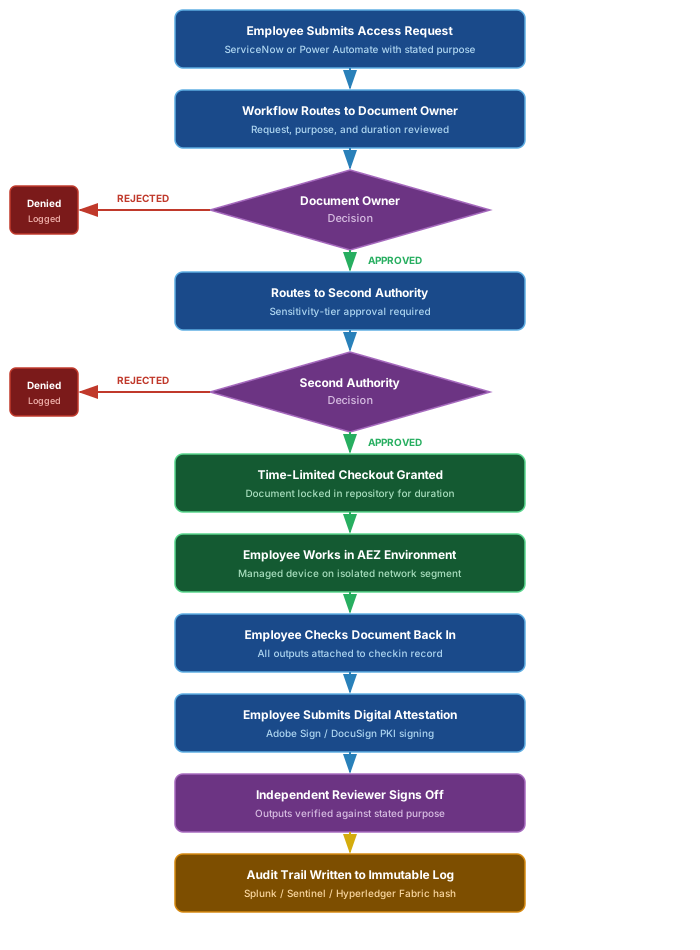
Figure 3. The complete checkout and checkin workflow. Two independent approvals are required before access. A separate independent reviewer must sign off at checkin before the document returns to active status.
A checkout workflow without mandatory signoff at checkin is incomplete. The checkin process requires the returning employee to attest to three things: that the document was only accessed on approved infrastructure, that no content was transferred to an AI system, and that any outputs created are attached to the checkin record.
A second reviewer, independent from both the requestor and the original approver, signs off on the checkin before the document is returned to active status. This review confirms that the attached outputs are consistent with the stated purpose and that no anomalies are apparent in the document's handling record.
Digital signatures for these attestations should use PKI-based signing through a platform like Adobe Sign with enterprise certificate management, or DocuSign's qualified electronic signature product, which produces a verifiable audit trail with timestamps, IP addresses, and certificate chain records. HashiCorp Vault or a hardware security module manages the signing keys and prevents any single administrator from unilaterally invalidating the record.
The complete audit trail covers the request, approval, checkout timestamp, checkin timestamp, attestations, reviewer signoff, and document hash before and after. It is written to an immutable log. In practice this means either a write-once storage system, a blockchain-anchored audit record using a private Hyperledger Fabric deployment, or a SIEM platform like Splunk or Microsoft Sentinel configured with tamper-evident log storage. The point is that no one, including system administrators, can edit the record after the fact.
Addressing the Obvious Objections
The first objection is that this is too slow for real work. It is slower than opening a file from a shared drive. It is significantly faster than responding to a regulatory investigation, managing a data breach notification, or explaining to a client why their confidential material appeared in a competitor's proposal. The overhead is a design constraint rather than a flaw. Workflows that need genuine speed should be reconsidering whether the data they are working with belongs in the AEZ at all.
The second objection is that it is too expensive to implement. The component costs in 2026 are actually quite reasonable. Purview, Zscaler or Netskope, and a mid-market document management platform can all be sourced under existing enterprise licensing frameworks. The true cost is implementation time and change management. That is a real investment but it is a one-time investment, whereas the cost of an AI-related data incident is ongoing and unpredictable.
The third objection is that it only works if employees follow the rules. This is only partly true. The technical controls at the endpoint, network, and repository layers are enforced without relying on employee compliance. The workflow and attestation layers add human accountability on top of technical enforcement. An employee who is genuinely determined to circumvent the system can probably find a way, as is true of any security control. The AEZ makes circumvention a deliberate act that leaves evidence rather than an accidental act that leaves no trace.
The Deeper Reason This Matters Now
There is a timing element here that is easy to underestimate. In 2026, the question of whether employees are feeding sensitive data to AI models is not hypothetical. It is happening at scale across every industry. The regulatory and legal frameworks for this behaviour are still forming. Organisations that build proper controls now will be demonstrating due diligence when those frameworks crystallise. Organisations that wait will be retrofitting under pressure, after an incident, or in response to a regulator who has already formed a view.
The AI-excluded zone is not an argument against AI in the workplace. It is the opposite. It creates the conditions under which AI can be used broadly and with genuine organisational confidence, because the highest-risk data has structural protections that do not depend on individual judgement calls made under time pressure.
Training people to be careful with sensitive data is necessary. Trusting only training to protect your most sensitive data is not enough.
A Practical Starting Point
If you are an information security, risk, or technology leader reading this and thinking about where to begin, the answer is not to build the full architecture on day one.
Start with classification. Work with your legal, finance, and HR leaders to define what data would be catastrophic if it appeared in an AI training set or was summarised by an external model without your knowledge. Be specific. Then find it. Use Microsoft Purview DSPM for AI, BigID, or Varonis Data Security Platform to discover where that data actually lives across your environment. The results will be illuminating.
From there, the network controls and the repository design follow naturally from knowing what you are protecting and where it currently sits. The workflow design comes from understanding who legitimately needs access and for what purposes.
The organisations that get ahead of this problem will be the ones that started the classification work before the incident made it urgent.
Sources and References
All tools and services mentioned in "The Vault Your AI Cannot Open"
Data Classification and Labelling
| Tool / Service | Description | URL |
|---|---|---|
| Microsoft Purview Information Protection | Sensitivity labelling and encryption that travels with documents through copy, export, and conversion operations | https://www.microsoft.com/en-us/security/business/information-protection/microsoft-purview-information-protection |
| Microsoft Purview AI Hub | Governance and visibility layer for AI interactions with enterprise data, including controls over what data AI agents can access and return | https://learn.microsoft.com/en-us/purview/ai-microsoft-purview |
| Microsoft Purview DSPM for AI | Data Security Posture Management for AI — discovers where sensitive data lives and how AI tools interact with it | https://learn.microsoft.com/en-us/purview/dspm-for-ai-considerations |
| BigID | Data discovery and classification platform that identifies and tags sensitive data locally without sending it to external services | https://bigid.com |
| Forcepoint Data Classification | Enterprise data classification and DLP for structured and unstructured data across on-premises and cloud environments | https://www.forcepoint.com/product/dlp-data-loss-prevention |
| OpenText Documentum | Enterprise content management platform with classification, records management, and access control capabilities | https://www.opentext.com/products/documentum |
Network and Endpoint Controls
| Tool / Service | Description | URL |
|---|---|---|
| Zscaler Zero Trust Exchange | Cloud-native security platform that categorises AI and ML applications and enforces inline DLP policy on file uploads and text paste to AI tools | https://www.zscaler.com/platform/zero-trust-exchange |
| Netskope Cloud Security Platform | Security service edge platform with GenAI DLP controls that monitor and restrict sensitive data pasted into tools like ChatGPT, Claude, and Gemini | https://www.netskope.com |
| Microsoft Purview Endpoint DLP | Endpoint-level data loss prevention that blocks copy, paste, and transfer of classified content on managed devices | https://learn.microsoft.com/en-us/purview/endpoint-dlp-learn-about |
| CrowdStrike Falcon Data Protection | Endpoint DLP that prevents data exfiltration to AI-capable applications, removable media, and local model runners | https://www.crowdstrike.com/platform/falcon-data-protection |
| Palo Alto Networks NGFW | Next-generation firewalls with AI-aware deep packet inspection and outbound connection policy to block AI service endpoints | https://www.paloaltonetworks.com/network-security/next-generation-firewall |
| Fortinet FortiGate | Enterprise firewall and network segmentation platform for software-defined isolation of the AEZ repository network segment | https://www.fortinet.com/products/next-generation-firewall |
Physical and Hardware Isolation
| Tool / Service | Description | URL |
|---|---|---|
| Waterfall Security Solutions | Hardware data diode manufacturer — enforces true one-way data flows using optical isolation, making reverse data transfer physically impossible | https://waterfall-security.com |
| Owl Cyber Defense | Cross-domain security solutions and data diode products for government, defence, and critical infrastructure environments | https://owlcyberdefense.com |
Document Repository and Management
| Tool / Service | Description | URL |
|---|---|---|
| M-Files | Intelligent document management with native check-out and check-in controls, version locking, and metadata-driven access policy | https://www.m-files.com |
| Laserfiche | Enterprise content management platform with workflow automation, version control, and immutable audit logging | https://www.laserfiche.com |
| DocuWare | Cloud and on-premises document management with automated workflows, version control, and tamper-evident audit trails | https://start.docuware.com |
| OpenText Content Suite | Enterprise content management platform with records management, check-out controls, and integration with Purview classification | https://www.opentext.com/products/content-suite-platform |
Access Workflow and Governance
| Tool / Service | Description | URL |
|---|---|---|
| ServiceNow | Enterprise workflow platform used for access request, dual approval routing, and automated escalation processes | https://www.servicenow.com |
| Microsoft Power Automate | Low-code workflow automation integrated with Microsoft Purview for access request and approval orchestration | https://powerautomate.microsoft.com |
| Onspring | GRC and workflow automation platform for governance, risk, and compliance processes including document access management | https://onspring.com |
| LogicGate Risk Cloud | Risk and compliance workflow platform for building structured access governance and signoff processes | https://www.logicgate.com |
Digital Signatures and Audit
| Tool / Service | Description | URL |
|---|---|---|
| Adobe Acrobat Sign | PKI-based qualified electronic signature platform producing verifiable audit trails with timestamps, IP addresses, and certificate chain records | https://acrobat.adobe.com/us/en/sign.html |
| DocuSign | Electronic signature and agreement cloud with qualified signature support and full audit trail for compliance attestations | https://www.docusign.com |
| HashiCorp Vault | Secrets management and cryptographic key management platform — prevents any single administrator from unilaterally invalidating signing records | https://www.hashicorp.com/products/vault |
Audit Logging and Monitoring
| Tool / Service | Description | URL |
|---|---|---|
| Splunk | Security information and event management (SIEM) platform configurable with tamper-evident, write-once log storage for immutable audit trails | https://www.splunk.com |
| Microsoft Sentinel | Cloud-native SIEM and security orchestration platform with tamper-evident log storage and integration with Purview activity data | https://azure.microsoft.com/en-us/products/microsoft-sentinel |
| Hyperledger Fabric | Open-source enterprise blockchain framework used to anchor audit records with cryptographic hashes, making post-facto tampering detectable | https://www.hyperledger.org/projects/fabric |
| Varonis Data Security Platform | Data security platform for discovering where sensitive data lives, monitoring access patterns, and detecting anomalous data activity | https://www.varonis.com |
Managed AI Platforms Referenced
| Tool / Service | Description | URL |
|---|---|---|
| Microsoft 365 Copilot | Microsoft's enterprise AI assistant integrated with Purview controls for governed AI use across productivity applications | https://www.microsoft.com/en-us/microsoft-365/copilot/microsoft-365-copilot |
| Salesforce Einstein | Salesforce's AI layer for CRM and business applications, cited as an example of a governed enterprise AI platform | https://www.salesforce.com/au/artificial-intellig |